Accurate and fast Next-Generation Sequencing (NGS) in-house testing solutions
Tumor alterations need to be analyzed on a molecular level to be matched with the best personalized therapies
Tumor profiling is essential for characterizing the molecular composition of tumors, as well as their spatial and temporal heterogeneity. We offer tumor profiling solutions using both tissue-based samples (FFPE and fresh frozen) and blood samples (liquid biopsies). These complementary approaches enable repeatable monitoring of tumor evolution and support the detection of mutations, genomic variations, and key biomarkers such as CNVs and MSI, all within a short turnaround time


High performing tumor profiling kits for a variety of cancers and genomic alterations
HP1 test panel assays provide unique designs, allowing the assessment a broad range of genomic alterations including SNVs, indels, CNVs, fusions, MSI for all assays as well as tumor fraction for the ctDNA version. HP1 is always a DNA-only workflow and also designed to be used with automation.
The HP2 ctDNA test panel assay is designed to be highly actionable and allows labs to assess a broad range of genomic alterations including SNVs, indels, CNVs, fusions, MSI and tumor fraction in a single DNA-only streamlined and robust lab-to-report workflow.
The HP3 ctDNA test panel assay has a unique design to assess a broad and actionable range of genomic alterations including SNVs, indels, CNVs, fusions, MSI and tumor fraction in a single DNA-only streamlined and robust lab-to-report workflow.
The HP RNA test panel assay allows the assessment of variations beyond simple fusions, including partner-agnostic fusion discovery, gene expression profiles and alternative splicing and splice variants with actionable exon skipping detection.

Powered by Hedera Prime software analysis

Save time with the Hedera Prime Software: more somatic reports delivered daily, faster

Pathogenicity / Oncogenicity Assessment
Pathogenicity/oncogenicity assessment through multiple databases‡ including Clinvar and OncoKB™ with relevant pre-sorting
OncoKB™ Knowledge base
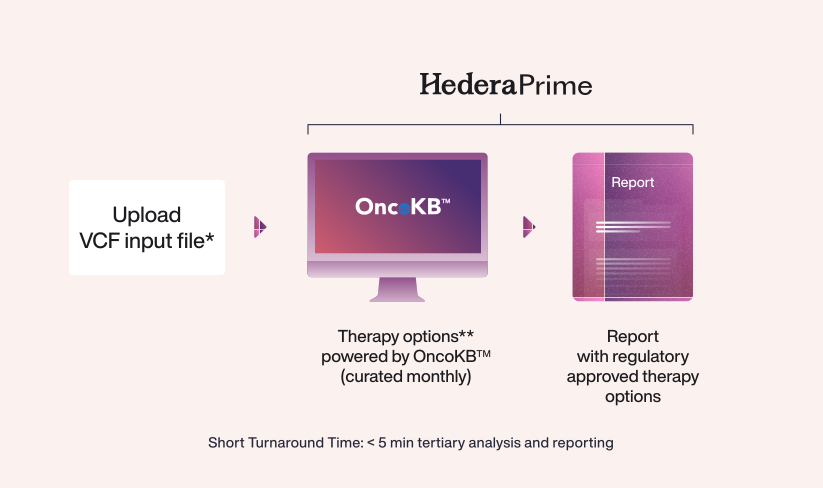
Hedera Prime integrates OncoKB™, precision oncology knowledge base which is updated monthly and curated by experts
Therapy options displayed in a customizable report
The report output suggests therapies options ranked by OncoKB™ Therapeutic Levels of Evidence and includes EMA and FDA approved drugs
“ESMO recommends that genomic reports include ranking of the genomic alterations for clinical actionability by valid ranking systems such as ESCAT or OncoKB™.” 1,2
Matching patient’s tumor alterations to regulatory approved therapy options with a simple solution
Regulatory-approved therapy options
Our therapy options feature associates a tumor's gene alterations with FDA- and/or EMA-approved drugs and identifies effective and ineffective therapies
Implementation support
Implementation support program (compliant with CE-IVDR and local validation requirements) is provided; Hedera Dx remains your validation partner all the way through
Seamless workflow integration
Hedera Prime software is designed to fit smoothly into your existing lab setting so you can run NGS tests quickly and efficiently
Easy to scale
Hedera Prime software allows you to easily scale up somatic NGS tests volumes by dramatically saving time on each report
.jpg)
.png)
Hedera Dx A validation partner for the Lab
Comprehensive implementation program available to facilitate the integration of compliant liquid biopsy in your lab.
The program provides onsite laboratory hands-on training, including a wet-lab instruction, a run assessment, a software training as well as a validation and technical support.

PSO assays are designed to run local performance validations studies in full compliance with the IVDR.
The Hedera Comply implementation support program provides you with all that you need to run a local validation and develop a compliant in-house IVD liquid biopsy solution.
From onsite laboratory hands-on training to routine follow-up, Hedera Dx remains your local validation partner all the way through.
* For VCF input Hedera Prime is considered to be used for Performance Studies Only. The performance evaluation of Hedera Prime has not been established in this setting and users can run a local validation under CE-IVDR.
** EMA (European Medicines Agency) therapy options is currently also available for NSCLC samples
‡ ClinVar, OncoKB, OMIM, gnomAD, dbSNP, Mastermind, BRCA Exchange
1. Mosele, F et al. “Recommendations for the use of next-generation sequencing (NGS) for patients with metastatic cancers: a report from the ESMO Precision Medicine Working Group.” Annals of oncology : official journal of the European Society for Medical Oncology vol. 31,11 (2020): 1491-1505.
2. Schmid, S et al. “How to read a next-generation sequencing report-what oncologists need to know.” ESMO open vol. 7,5 (2022):100570. doi:10.1016/j.esmoop.2022.1005701.
